Egypt
The Vampire LestatEgypt is both a destination and an interpretive landscape in Lestat’s account: he travels there hoping its ancient grandeur will distract him from events he cannot change, but the country instead sharpens his sense of the vampires’ relationship to death and antiquity. Its temples and myths prompt questions about the origins of vampire customs and the enigmatic knowledge of Marius.
Destination and Arrival
Lestat tells himself that going south will let Egypt’s ancient grandeur and timeless marvels make him forget what is happening in Paris and what he cannot alter. He also recognizes a deeper attraction: in his mind, Egypt is more than any other land a place in love with death. Gabrielle eventually joins him, emerging from the Arabian desert, and they sail together. The voyage to Cairo takes almost a month. Once there, Lestat finds his belongings waiting at a European hostelry, along with a package bearing Eleni’s handwriting; its arrival introduces news from Paris into the distance he had sought.
Ancient Landscapes and Monuments
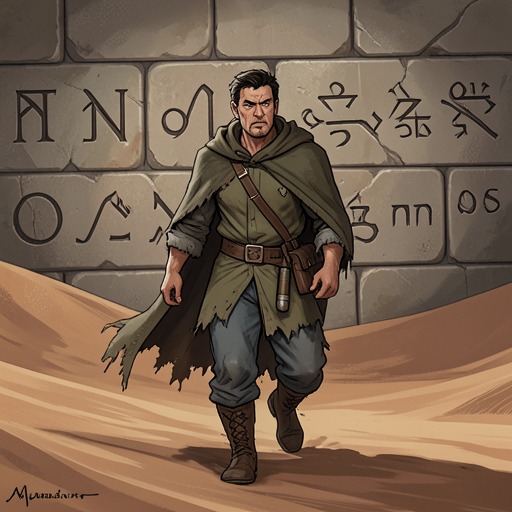
In Egypt, Lestat experiences the landscape as if it had hardly changed across thousands of years. He finds it natural that the moonlit palms, the peasant drawing water from the river, and the cattle beside him should resemble the world represented in paintings on royal tomb walls. The impression brings him visions of the world when it was new, while also making him wonder whether Marius had once stood in the same sands.
Lestat and Gabrielle wander through the giant temple of Ramses, where millions of small images are cut into the walls, and explore the ruins of Luxor. They lie together on a riverboat beneath the stars. On the return journey to Cairo, they pass the Colossi of Memnon; Gabrielle points out that Roman emperors once travelled to marvel at the statues, as they are doing. The monuments thus place their journey within a succession of visitors who have encountered Egypt as an already ancient world.
Myth, Burial, and Vampire History
Lestat’s reading in the old Venetian palazzo he haunts prepares him to see Egyptian myth as a possible key to vampire history. While studying accounts of Osiris, he is struck by the story of the king who teaches cultivation and winemaking, is shut inside a box made to his body’s exact dimensions, and is later dismembered by his brother Typhon. Lestat connects the coffin-shaped box to the rule that vampires must sleep in coffins fitted to their bodies, a custom he recognizes even among the poor vampires of Les Innocents. He also links Osiris’s missing body part and his inability to procreate to the vampire condition, which does not grant that human capacity. In the myth, Osiris becomes Lord of the Dead.
These connections do not resolve into certainty. Lestat wonders why Marius referred to a myth like this and whether the sanctuary in Armand’s dream, where the ancient vampires were kept, might reach back to Egyptian times. He also considers that Marius’s reference to Typhon may have been no more than a poetic allusion. Gabrielle cautions that Osiris was a good Egyptian god associated with grain and urges Lestat to read other ancient stories of gods mourned after being dismembered. Her response broadens his inquiry without confirming his theory.
Distance, News, and Significance
Egypt gives Lestat a setting in which the past seems continuous with the present, but it cannot sever his connection to the upheaval in France. The package from Eleni contains a letter reporting that, after the attack on the Bastille on July 14, mobs and riots had spread through France. Peasants and tenant farmers had risen against Lestat’s father’s house; his brothers, their wives and children, and the castle’s defenders had been killed, while his father survived and reached New Orleans. The letter asks Lestat to come to his father’s aid. Egypt’s distance therefore becomes the setting for a return of the family crisis he hoped to escape.
As a location in the narrative, Egypt joins travel, historical imagination, and vampire lore without turning Lestat’s conjectures into established answers. Its monuments make antiquity feel present; its mythology gives him a framework for interpreting coffins, death, and the limits of the Dark Gift; and the news arriving there pulls him back toward the consequences of the French Revolution.